

Where to find it: Main → Shipping → Returns — Open in OTO ↗
The problem it solves
The cost of a return is rarely the refund. It is the handling: someone answering an email, someone booking a collection, a parcel arriving at a warehouse with no paperwork, a box that sits on a bench for a week because nobody knows whether it was approved, and a customer who has neither their money nor their item and is now telling people about it. Underneath that is an uncertainty problem. Until someone physically opens the box, you do not know what came back, in what condition, or whether the refund you already promised was the right one. Every step that happens before that moment is a guess, and every guess that turns out wrong costs money twice.Two ways a return starts
Both land in the same place: the Returns screen, as a request with its own identifier. A return carries the order number with a return suffix — OID-10288-10120-R1 — so a second return against the same order is distinguishable from the first.
A failed delivery is not thisAn undelivered parcel coming back to you is a return to origin, and it travels a different path — see Returns receiving. The returns covered here are the ones a customer asks for, on an order they already have.Keeping the two separate matters: they have different causes, different costs and different fixes. Counting them together hides both.
The lifecycle
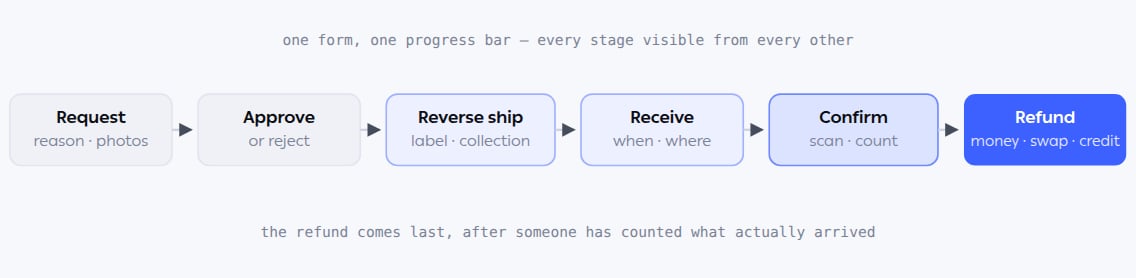
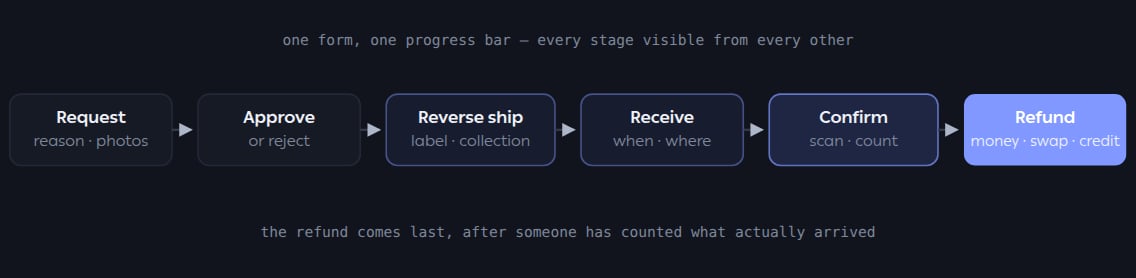
The order of these is the point. Refunding before confirming is the most common and most expensive way to run returns.
Where it lives
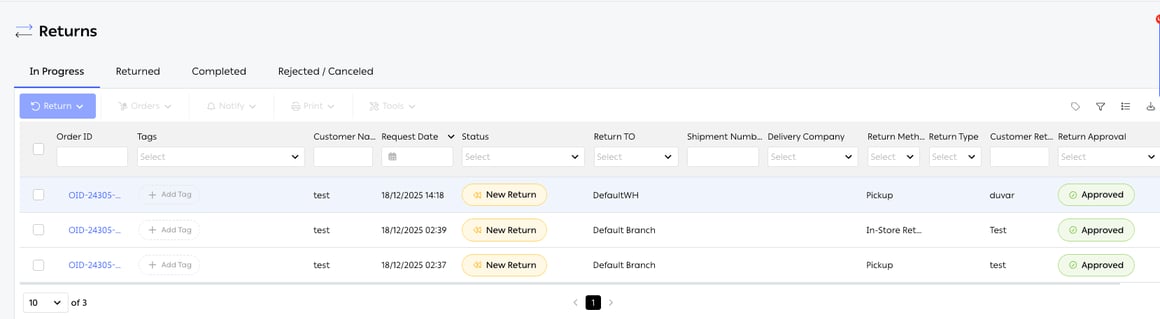
Fig. 1 — Status tracks where the return itself has got to; Return Approval is a separate column, because a return can be approved and still be at the very start of its journey.
Who runs it
Functions in this module
Customer returns
4 features
Returns receiving
5 features
Return automation
3 features
What it connects to
- Customer Notification — the three return messages and the portal link.
- Inbound and putaway — the Return bin returned stock lands in.
- Inventory tracking — what a confirmed return puts back.
- Shipping automation — choosing the carrier for the return leg.